 Emberwood
Small Businesses Don’t Need More Marketing Tools. They Need Marketing That Gets Done.
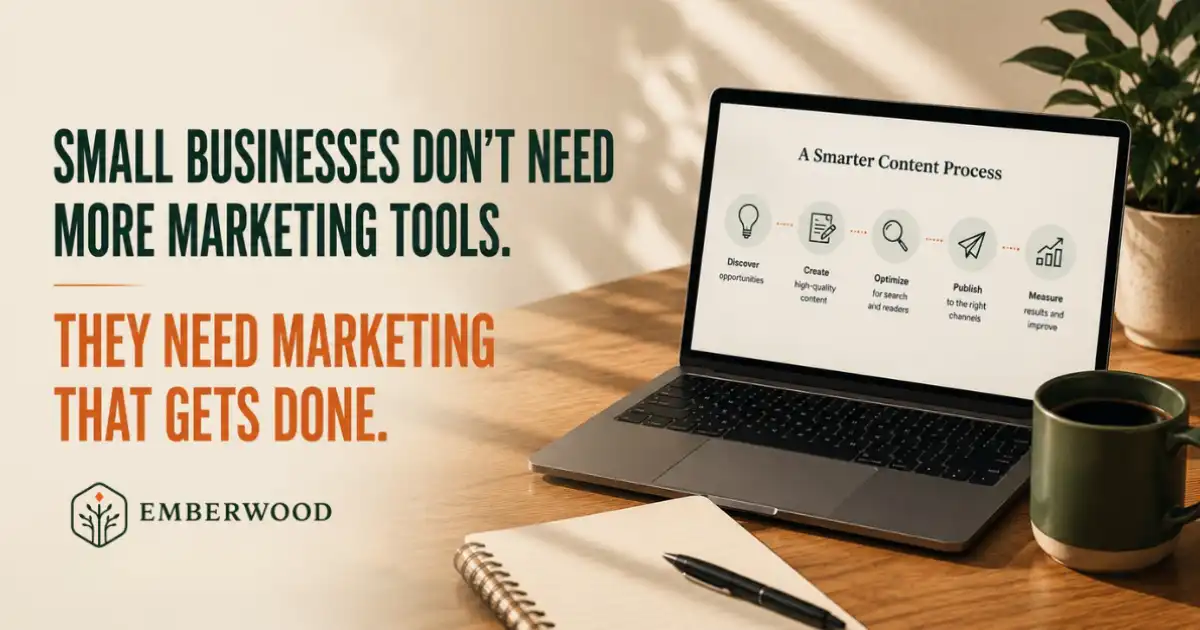
Small business owners have never had more marketing tools available to them. There are platforms for SEO, analytics, social media, email marketing, content calendars, keyword research, website management, design, and now artificial intelligence.
In theory, marketing should be easier than ever. For many businesses, it isn’t.
The problem is no longer a lack of tools. Most of those tools still require someone to operate them. A business owner might have software that can generate an article in seconds, but someone still has to decide what the article should be about, determine whether the topic matters to customers, review the writing, optimize it for search, find an image, publish it, and eventually figure out whether it accomplished anything.
Multiply that across every blog post, every week, and content marketing quickly becomes another job.
AI Made Content Faster. It Didn’t Make Content Marketing Automatic.
Generative AI has significantly reduced the time required for many content-creation tasks, and that is genuinely useful. But writing is only one part of content marketing.
Before an article gets written, someone still needs to decide what to talk about, who the content is meant to reach, which products or services deserve attention, what questions customers are asking, what has already been covered, and where meaningful content gaps may exist.
After the article is written, another layer of decisions appears. When should it be published? What title should it use? Does it fit the brand? Should it link to another page? What image belongs with it? Did it perform well? What should be learned from the result?
A tool that only generates the article solves one piece of the problem. The rest of the work remains.
The Blank Prompt Box Is Still Work
There is something revealing about the way many AI tools begin. They present you with an empty box and ask what you would like them to do.
For plenty of tasks, that makes perfect sense. For ongoing marketing, though, the blank box quietly shifts the responsibility back to the business owner. You still need to know what to ask, what matters most, and what should happen next.
A more useful system would begin with context. It would understand what the business does, which products and services matter most, who the business is trying to reach, what has already been published, and what goals the company is trying to accomplish. It could then use that understanding to recommend what should happen next instead of waiting for the owner to invent another prompt.
The goal should not simply be to help someone create content faster.
The goal should be to reduce how much of the content-marketing process they have to manage at all.
Your Existing Content Should Teach the System Something
A business website already contains a tremendous amount of useful information. Its service and product pages help explain what the company offers. Its location pages can indicate where it operates. Its existing articles show what topics it has covered, while its language provides clues about tone, positioning, and the way the business speaks to customers.
Historical content may also reveal patterns. Some subjects may consistently attract more traffic. Certain article formats may perform better than others. Particular audiences, products, or services may receive far more coverage than others.
That information should not disappear every time someone opens a new AI conversation. An intelligent content system should build on it and gradually develop a clearer picture of the business and its publishing history.
That creates an opportunity to move beyond isolated content generation. Instead of simply asking whether AI can write a blog post about a given topic, businesses can begin asking a more useful question:
What should we publish next, and why?
That is a fundamentally different use of AI.
Content Marketing Should Learn From Results
Traditional content calendars often operate mostly in one direction. Choose a topic, publish it, and move on to the next one. Analytics may exist somewhere else, but they do not necessarily influence the next decision.
A smarter system should create a feedback loop. It can examine existing content, identify patterns, form hypotheses about what appears to work, create new content based on those observations, and then measure the results.
Those patterns should not automatically be treated as proof. A post published on Tuesday performing well does not necessarily mean Tuesday caused the improvement. A certain topic performing better may reflect search demand, seasonality, promotion, competition, or any number of other variables.
But patterns provide evidence worth investigating.
As more content is published, those hypotheses can be tested and refined. Over time, the content strategy can become more informed instead of repeatedly starting from scratch.
Automation Shouldn’t Mean Losing Control
There is another reason many businesses hesitate to automate content marketing: they do not want a machine publishing whatever it wants on their website.
That concern is reasonable, but automation does not have to be all or nothing.
Some businesses may want to review every article, title, image, and recommendation before anything goes live. Others may eventually become comfortable letting routine content publish automatically once the system has earned their trust.
A useful platform should adapt to the level of oversight the business wants. At one end of the spectrum, AI researches and prepares content while a person approves the final result. At the other, the system handles most of the process with minimal intervention while alerting the owner only when something genuinely requires attention.
The important part is that control remains available without making constant supervision mandatory.
The Next Step Isn’t a Better Writing Tool
Small businesses already have access to excellent writing tools. The bigger opportunity is building systems that can take responsibility for more of the work surrounding the writing.
That means understanding the business before suggesting a topic. It means remembering what has already been published instead of starting from zero. It means spotting gaps, prioritizing opportunities, creating content, measuring results, and using those results to make the next decision better.
That is the direction we believe small-business content marketing is heading.
Instead of asking business owners to become better at operating marketing software, the software should become better at understanding what those owners are trying to accomplish. The business should manage its goals and preferences. The system should manage more of the process.
That is what we are building at Emberwood.
Not another place to generate words, but a way to make content marketing feel handled.
Ready for content marketing that feels handled?
Emberwood is being built to help small and midsize businesses turn content marketing into an ongoing system—not another task to manage. Join the waitlist for product updates and early-access opportunities.